

Do You Think Criminals Benefit More From Community Service Or House Arrest? Explain.
Executive Summary
- The United States spends almost $300 billion annually to police communities and incarcerate 2.two meg people.
- The societal costs of incarceration—lost earnings, adverse health effects, and the damage to the families of the incarcerated—are estimated at upwardly to three times the direct costs, bringing the total burden of our criminal justice system to $ane.2 trillion.
- The outcomes of this expense are only a marginal reduction in crime, reduced earnings for the convicted, and a high likelihood of formerly incarcerated individuals returning to prison.
- The value citizens identify on the small-scale increases in deterrence is hard to quantify, but as a affair of logic information technology must be substantial to merit incurring the measured costs.
Introduction
A criminal justice system is vital to ensuring laws are obeyed, the public is safety, and rights are protected. Key elements of such a system include incapacitating people who take cleaved the police, deterring others from doing the same, and rehabilitating offenders to forbid reoccurrence. A fair and just system must provide due process, protect the rights of the innocent, and provide those protections as to all people. Further, victims of crimes should be compensated for their sufferings and made whole, insofar as it is possible. To the extent these goals are achieved, such outcomes are the benefits of a robust criminal justice system and an indication of its effectiveness. The resource employed to attain those outcomes, also as any errors and collateral impairment caused in the pursuit of justice, are the costs. The extent to which the benefits outweigh the costs are a reflection of the organization's efficiency.
This paper analyzes the significant costs of the U.S. criminal justice system. Costs are measured in terms of the direct costs (budget outlays) too as indirect costs (the social and economical consequences of the punishments imposed, arresting and imprisoning the incorrect person, unnecessary injuries and fatalities sustained during arrest and imprisonment, etc.). Equally detailed below, the costs are substantial.
In contrast, the benefits are harder to summate. A well-operation criminal justice organisation may exhibit low or falling crime rates, depression recidivism rates, and the power to move on with one'due south life afterwards a person'due south judgement has been served or debt paid, every bit well as the ability of victims to be compensated for the wrongs committed against them. But the value of these attributes is subjective and will differ from individual to private based on a personal evaluation of safety, life, and property.
The Cost of the U.S. Criminal Justice System
Direct Costs
The direct governmental toll of our corrections and criminal justice system was $295.half dozen billion in 2016, co-ordinate to the Bureau of Justice Statistics.[1] With more than than two.2 million people incarcerated, this sum amounts to almost $134,400 per person detained.
Roughly one-half of these funds—$142.5 billion—are dedicated to police protection. The adjacent largest share of this expense—$88.5 billion—is the cost of operating the nation's prisons, jails, and parole and probation systems. The remainder—$64.7 billion—is spent on the judicial and legal systems.[ii] As shown in the post-obit chart, local governments pay more than one-half of the total costs—generally for policing, while the federal authorities pays just 1-6th.[3] States spend the most on corrections, a reflection of the fact that about sixty percent of all detainees (1.3 million people) are held in state prisons.[4]
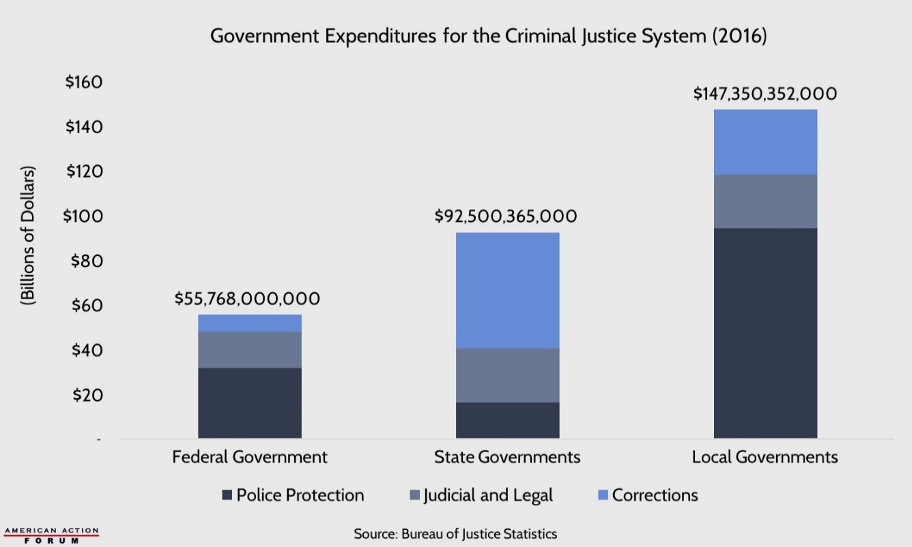
Of course, these figures practice not include the costs to individuals cited, arrested, and detained, or to their families. A 2015 study found that the average court costs for someone arrested was $xiii,607.[5] Based on this estimate, the cost to the ii.two 1000000 currently incarcerated individuals and their families would total $29.nine billion.
Indirect Costs
The cost of the criminal justice arrangement extends far beyond those direct costs of policing, prosecuting, and incarcerating.
Economical and Fiscal Losses
A report from Washington University in St. Louis estimates that the broader societal costs put the total burden at nearly $1.two trillion, after accounting for consequences such as foregone wages, adverse health furnishings, and the detrimental effects on the children of incarcerated parents, equally detailed below.[half-dozen] Other studies have noted similar indirect costs.[7]
For example, the cost of injuries while incarcerated, the three and a half times higher mortality rate experienced by formerly incarcerated individuals, and the detrimental wellness furnishings experienced by people imprisoned and their families—particularly college rates of poor mental wellness and infant bloodshed—are estimated to cost more than $100 billion.[8]
Costs related to moving, eviction, and homelessness for incarcerated individuals and their families, as well as the reduction in property values that may result from high rates of formerly incarcerated living in a particular area are estimated at $14.viii billion.[9]
For many, the personal costs exercise not finish upon release from prison. Being convicted of a crime helps perpetuate, though does not necessarily crusade, the bike of poverty. Incarceration limits economic opportunities and access to public assistance and housing.
The perpetuation of poverty is due to a multitude of factors, including the fact that being arrested or convicted of a crime makes it much more likely an private will lose job opportunities and thus the ability to earn legal wages. More lxx percentage of employers report conducting criminal background checks on job applicants.[10] Besides employers beingness less likely to rent someone with a criminal record, many jobs are automatically no longer available: Individuals convicted of a misdemeanor are barred from obtaining more than ane,000 occupational licenses; people convicted of a felony are barred from 3,000 licenses beyond the country.[xi] The cost of foregone wages while people are incarcerated combined with the lifetime reduction in earnings after their release is estimated at more than than $300 billion.[12]
A written report by the Brookings Institution found that but 55 percent of sometime prisoners had whatsoever earnings in the yr following release, and of those, only 20 pct (or eleven per centum of the full) earned more than the federal minimum wage (roughly $15,000).[13] While these figures largely reflect the experiences of individuals prior to their time in prison, every bit noted here, some other study found at least a 24 percentage-signal drop in employment among those who were steadily employed earlier being incarcerated for a twelvemonth or more.[fourteen] Farther, the aggregate figures obscure distinctions, and there are stark racial differences in the likelihood of being unemployed, as shown in the chart beneath. The greatest deviation in mail service-incarceration unemployment rates compared to the full general population is for Black women—a difference of 37.2 pct. White men faced the weakest incarceration penalty with a difference of 14.1 percent.
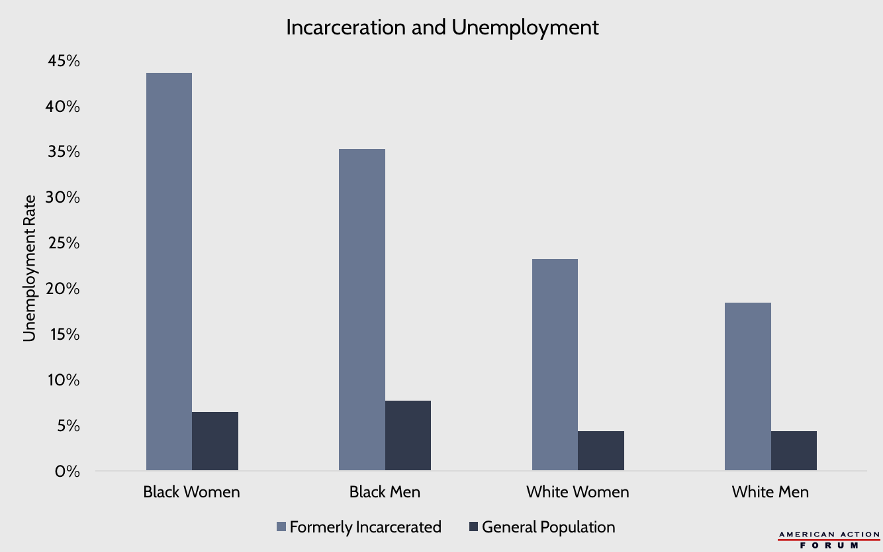
Source: Prison house Policy Initiative
The effects on economical growth extend beyond the individual incarcerated: x per centum of incarcerated people's children do not finish high school or attend college (nearly double the national high school dropout rate of 5.4 percentage), often choosing to leave schoolhouse and enter the labor force early in club to brand upwardly for the lost wages of their parent.[15] The reduced educational attainment and subsequent reduction in wages for these children is estimated equally a $thirty billion loss, or roughly $15 billion more than what might otherwise be expected.[16] Further, the children of incarcerated individuals are five times more than likely to go to prison themselves, compared with children whose parents are non incarcerated.[17] The increased charge per unit of criminality amongst children with incarcerated parents has a toll of $130.6 billion.[18]
Incarcerated individuals also experience higher rates of divorce and lower rates of wedlock, which is estimated to reduce economic growth by $26.seven billion and increase child welfare costs by $five.3 billion.[19]
Incarceration is likewise correlated with large discrepancies in wealth accumulation: Among people aged 29-37 in 2000, personal wealth averaged over $fourscore,000 for those never incarcerated, but less than $10,000 for those who were.[twenty] Here, the racial disparity is so severe that formerly incarcerated Whites notwithstanding accumulated more wealth than never incarcerated Blacks. Ultimately, imprisonment leads to reduced lifetime earnings of up to 40 per centum.[21]
Incarceration may limit admission to the social prophylactic internet. Following passage of the 1996 welfare reform constabulary, anyone convicted of a drug-related felony is ineligible for greenbacks assistance through the Temporary Assistance to Needy Families (TANF) in 74 percentage of states or the Supplemental Nutrition Help Plan (SNAP) in 70 percent of states, as of 2014.[22] Public housing authorities may deny housing help to individuals with a criminal record, even for non-vehement offenses.[23]
Naturally, the degree to which whatever of these negative societal outcomes are acquired by incarceration or just correlated with the incarcerated population is difficult to determine. What the data do show is that those who are incarcerated or who rely on the incarcerated for fiscal support practice poorly on multiple fronts compared to those who never find themselves in prison. This fact makes economical mobility and mail service-incarceration rehabilitation exceedingly, and perhaps unnecessarily, difficult.
Social Losses
Failure to pay debts owed may also result in the loss of voting rights. In 2010, 10 million people beyond the United States owed a commonage $fifty billion in fees, fines, and charges to the criminal justice arrangement.[24] A recent study from the Georgetown Police Ceremonious Rights Clinic found that at least 30 states condition reinstatement of voting rights on the completed payment of legal debt.[25] Those xxx states are home to over half of the formerly incarcerated but currently disenfranchised population.
Loftier rates of incarceration too erode trust in governmental institutions among people who believe they or others were unjustly imprisoned and weaken the connections in communities that are vital to creating a sense of belonging.[26] These consequences may in plough create a cycle of crime and incarceration.[27] Studies have shown that people who lose their connections to a community may be more likely to participate in criminal activeness: Similar to the way homeowners tend to take better care of their living space than renters, people who feel a sense of belonging to their customs are less likely to engage in subversive behavior.[28] People who feel ostracized may develop feelings of anger, frustration, and hostility which may ultimately result in crime.[29]
Errors and Collateral Damage
Errors made in the pursuit of justice add to the social costs. Errors include arresting the wrong person and wrongful convictions, deaths in law custody, deaths of bystanders, and damage to property while in pursuit of an offender, among others.
Since 1989, 367 individuals accept been exonerated by Deoxyribonucleic acid show proving their innocence; these wrongly bedevilled individuals served an boilerplate of 14 years in prison.[30] In nearly half of these cases, the actual offender was later identified and 41 percent had gone on to commit additional violent crimes while they were free.[31] Nigh 3 out of 10 individuals wrongly convicted had provided false confessions, half of whom were 21 years quondam or younger at the time of their arrest.[32]
Since 2013, law have killed more than viii,260 people, a rate of 33.5 per 10 meg population.[33], [34] The data evidence no correlation between the trigger-happy crime rate in a urban center and the frequency of police force killings.[35] Ane-quaternary of those killed were Black while 44 percentage were White, making a Black person iii times more probable to be killed by police than a White person, subsequently accounting for population by race in the Usa.[36] More than ane,100 people killed by police were unarmed at the time, and Black people killed were more than probable to be unarmed: 17 percent of Black people killed by police force were unarmed, compared with thirteen percent of White people.[37]
The Benefits of Incarceration to Club
A well-functioning criminal justice organisation should brandish low crime rates, low recidivism rates, the ability to compensate victims for harms committed against them, and equal access to justice and protection from crimes. As detailed higher up, the U.s.' criminal justice system has significant costs—directly and indirect—for both taxpayers and the accused offenders. Despite the significant costs, inquiry has repeatedly shown that the impact of the high incarceration rate is pocket-size and diminishing.[38]
Crime Rates
A central indication of the success of a criminal justice system is a low or declining criminal offence rate, and the crime rate in the The states has been declining for decades. [39] The significant increase in incarceration, however, was probable non necessary to achieve those gains. One study found a ten percent increase in incarceration led to a decrease in offense of just 2 percent.[40] Similarly, longer sentences do non meaningfully increase deterrence.[41] Following a policy change in California, ane written report plant that one additional year of incarceration had no upshot on violent crime merely led to a decrease of one to 2 property crimes per prisoner. Based on the high cost of imprisonment and the written report'south calculation of the express societal value of the small reduction in property crimes, the country yielded a net loss of $40,000 per prisoner.[42]
Recidivism
The high incarceration rates and long sentences that characterize the U.S. criminal justice system also do not yield the low rates of recidivism that are desired. The criminogenic nature of prison—its tendency to cause or reinforce criminal behavior—may atomic number 82 to increased crime. Evidence shows that one-3rd of people released from prison will return at some betoken.[43] A study from the U.S. Sentencing Committee constitute that nearly half of federal prisoners were rearrested inside 8 years of their release, and 1-third were reconvicted and 1-quaternary were reincarcerated.[44] Other studies have found re-arrest and reincarceration rates as loftier every bit 77 and 55 pct, respectively, for state prisoners.[45] A study of convicted individuals in Texas, whose boilerplate age was 30, establish that each boosted year sentenced increased the likelihood of mail service-release criminal activity by 4 to 7 percentage points per quarter.[46] In Chicago, individuals detained as juveniles were 22 to 26 percent more likely than their peers to re-offend and xiii percent less likely to graduate from loftier school.[47]
Restitution and Victim Compensation
The Usa does have systems in place to compensate victims of crime. Every land has laws pertaining to the payment of restitution by convicted offenders. These payments are intended to make the victim "whole" again by paying for amercement and financial losses as a effect of the crime committed; losses may include the cost of a funeral, lost wages, or medical expenses.[48] Depending on the offender'due south financial situation, however, any payment required may be minimal, if anything at all. Every country likewise operates a crime-victim compensation fund, which similarly makes funds available to crime victims to encompass expenses that result from the crime committed against them.[49] Each state has a maximum compensation corporeality for which a victim may be eligible, which averages $25,000.[fifty] Nevertheless, xl per centum of victims indicated that their needs were non met past these programs.[51]
Equal Access to Justice
The U.S. Constitution requires equal protection under the law, but in many ways the criminal (and civil) justice organisation falls curt. Despite the accused having a constitutional right to legal counsel, many states require payment for a public defender. Studies estimate that between 66 percent and ninety pct of felony defendants cannot beget to hire attorneys and nearly 7,000 more than public defenders are needed to adequately handle the current example load in the United States.[52] Those who are able to afford a public defender, just not a private attorney, are more likely to exist held in pre-trial detention and jailed.[53]
Lower-income individuals are also more likely to be victims of all types of personal criminal offence.[54] People in poor households, relative to people in high-income households, were more than twice equally likely to exist a victim of nonfatal violent crime and more than three times equally likely to be the victim of serious violent law-breaking.[55] Being a victim of offense can cause emotional harm and lead to lost earnings, perhaps perpetuating the likelihood of remaining in poverty.[56]
Decision
The United States spends nearly $300 billion annually to law, prosecute, and imprison. As arrest and conviction rates take increased and sentences for many crimes have gotten longer, the country now incarcerates more 2.two meg people, or most 700 people per 100,000. In addition to the direct costs of the criminal justice system, there are substantial societal costs associated with such a high incarceration charge per unit, including considerable reductions in economic growth as well as adverse health effects for both the incarcerated and their families. The impact of incarcerating and then many people has been only minimal reductions in crimes. The high rates of backsliding signal imprisonment does not deter time to come crime nor rehabilitate offenders.
[ane] https://www.bjs.gov/index.cfm?ty=pbdetail&iid=6728, Tabular array 1
[2] https://www.bjs.gov/index.cfm?ty=pbdetail&iid=6728, Tabular array ane
[3] https://www.bjs.gov/index.cfm?ty=pbdetail&iid=6728, Table 1
[4] https://world wide web.prisonpolicy.org/reports/pie2020.html
[v] http://whopaysreport.org/wp-content/uploads/2015/09/Who-Pays-FINAL.pdf
[half dozen] https://joinnia.com/wp-content/uploads/2017/02/The-Economic-Brunt-of-Incarceration-in-the-US-2016.pdf The total burden noted hither accounts for the increase in direct costs that have occurred since this study was washed as well every bit accounts for a broader range of direct costs, as noted above.
[vii] https://static.prisonpolicy.org/scans/vera/the-price-of-prisons.pdf, https://www.jstor.org/stable/23292002?seq=1, https://www.publichealthpost.org/research/incarcerations-costs-for-families/, https://measuresforjustice.org/_next/static/files/1c41bf506c73a865fd4d57807ed297bf/Incarceration_Weakens_Community_Immune_System_Preliminary_Results.pdf
[8] https://joinnia.com/wp-content/uploads/2017/02/The-Economic-Brunt-of-Incarceration-in-the-The states-2016.pdf
[9] https://joinnia.com/wp-content/uploads/2017/02/The-Economic-Brunt-of-Incarceration-in-the-U.s.-2016.pdf
[10] Holzer, Harry J., Steven Raphael, and Michael A. Stoll. 2006. "Perceived Criminality, Criminal Background Checks, and the Racial Hiring Practices of Employers." Journal of Law and Economics 49(two): 451-480.
[xi] American Bar Clan. 2016. "National Inventory of Collateral Consequences of Confidence." American Bar Association. <http://www.abacollateralconsequences.org/search/>.
[12] https://joinnia.com/wp-content/uploads/2017/02/The-Economic-Burden-of-Incarceration-in-the-U.s.-2016.pdf
[13] https://world wide web.brookings.edu/wp-content/uploads/2018/03/es_20180314_looneyincarceration_final.pdf
[14] https://sites.lsa.umich.edu/mgms/wp-content/uploads/sites/283/2015/09/incar.pdf
[15] https://nces.ed.gov/fastfacts/display.asp?id=16
[16] https://joinnia.com/wp-content/uploads/2017/02/The-Economic-Burden-of-Incarceration-in-the-US-2016.pdf
[17] https://joinnia.com/wp-content/uploads/2017/02/The-Economical-Burden-of-Incarceration-in-the-US-2016.pdf
[18] https://joinnia.com/wp-content/uploads/2017/02/The-Economic-Brunt-of-Incarceration-in-the-US-2016.pdf
[nineteen] https://joinnia.com/wp-content/uploads/2017/02/The-Economic-Burden-of-Incarceration-in-the-Usa-2016.pdf
[20] https://world wide web.prisonpolicy.org/blog/2016/04/26/wealth/
[21] https://pdfs.semanticscholar.org/5156/99b3bacf2a82ff98522675ccb3ec0ea16d6d.pdf
[22] https://www.lac.org/assets/files/TANF_SNAP_Drug_Felony_Ban_LAC_one-pager_2.pdf
[23] Curtis, Marah A., Sarah Garlington, and Lisa South. Schottenfeld. 2013. "Alcohol, Drug, and Criminal History Restrictions in Public Housing." Cityscape: A Journal of Policy Development and Research 15(3): 37-52.
[24] https://jjrec.files.wordpress.com/2014/08/debtpenalty.pdf
[25] https://campaignlegal.org/sites/default/files/2019-07/CLC_CPCV_Report_Final_0.pdf
[26] https://press.uchicago.edu/ucp/books/volume/chicago/A/bo18008991.html, http://citeseerx.ist.psu.edu/viewdoc/download?doi=x.1.one.515.4068&rep=rep1&type=pdf
[27] https://world wide web.jstor.org/stable/10.1086/522360?seq=i
[28] https://theconversation.com/what-makes-a-criminal-friends-parents-and-their-failings-play-a-big-function-66582
[29] https://www.researchgate.net/publication/282356391_The_Unravelling_of_Identities_and_Belonging_Criminal_Gang_Involvement_of_Youth_from_Immigrant_Families
[thirty] https://www.innocenceproject.org/deoxyribonucleic acid-exonerations-in-the-united-states/
[31] https://www.innocenceproject.org/dna-exonerations-in-the-united-states/
[32] https://www.innocenceproject.org/dna-exonerations-in-the-united-states/
[33] https://mappingpoliceviolence.org/
[34] https://www.prisonpolicy.org/blog/2020/06/05/policekillings/
[35] https://mappingpoliceviolence.org/
[36] https://mappingpoliceviolence.org/
[37] https://mappingpoliceviolence.org/
[38] https://obamawhitehouse.archives.gov/sites/default/files/page/files/20160423_cea_incarceration_criminal_justice.pdf
[39] https://www.pewresearch.org/fact-tank/2019/x/17/facts-about-criminal offence-in-the-u-s/
[40] Donohue, John. 2009. "Assessing the Relative Benefits of Incarceration: The Overall Alter Over the Previous Decades and the Benefits on the Margin." In Do Prisons Make Us Safer? The Benefits and Costs of the Prison house Boom, Raphael, Stephen and Michael Stoll, eds. Russell Sage Foundation, New York, NY.
[41] https://obamawhitehouse.archives.gov/sites/default/files/page/files/20160423_cea_incarceration_criminal_justice.pdf
[42] Lofstrom, Magnus, and Steven Raphael. 2013. "Public Safety Realignment and Crime Rates in California." Public Policy Constitute of California.
[43] https://www.brookings.edu/wp-content/uploads/2018/03/es_20180314_looneyincarceration_final.pdf
[44] https://sentencing.umn.edu/sites/sentencing.umn.edu/files/recidivism_among_federal_offenders_2016.pdf
[45] https://obamawhitehouse.archives.gov/sites/default/files/page/files/20160423_cea_incarceration_criminal_justice.pdf
[46] Mueller-Smith, Michael. 2015. "The Criminal and Labor Market Impacts of Incarceration."
Working Newspaper.
[47] Aizer, Anna and Joseph J. Doyle, Jr. 2013. "Juvenile Incarceration, Human Majuscule and Future Crime: Evidence From Randomly-Assigned Judges." National Bureau of Economic Inquiry. Working Newspaper 19102
[48] https://www.nolo.com/legal-encyclopedia/restitution-law-victims-criminal offence.html
[49] http://www.nacvcb.org/NACVCB/files/ccLibraryFiles/Filename/000000000120/BrochureCVC1.pdf
[50] http://www.nacvcb.org/NACVCB/files/ccLibraryFiles/Filename/000000000120/BrochureCVC1.pdf
[51] https://nij.ojp.gov/topics/manufactures/criminal offence-victim-awareness-and-assistance-through-decades
[52] https://www.americanprogress.org/issues/criminal-justice/reports/2016/12/08/294479/making-justice-equal/
[53] https://www.americanprogress.org/issues/criminal-justice/reports/2016/12/08/294479/making-justice-equal/
[54] https://world wide web.brookings.edu/blog/up-front/2014/04/28/the-diff-burden-of-crime-and-incarceration-on-americas-poor/
[55] https://world wide web.bjs.gov/content/pub/pdf/hpnvv0812.pdf
[56] https://www.brookings.edu/blog/upwardly-front/2014/04/28/the-unequal-brunt-of-criminal offense-and-incarceration-on-americas-poor/

Source: https://www.americanactionforum.org/research/the-economic-costs-of-the-u-s-criminal-justice-system/
Posted by: greathouseinart1972.blogspot.com
0 Response to "Do You Think Criminals Benefit More From Community Service Or House Arrest? Explain."
Post a Comment