

Ab Investigative Services (Abis) Inventory And Warehouse Management: How Do We Handle Returns?
Ecommerce has transformed the fashion businesses sell. Simply aircraft products to global customers comes with its own set of challenges—specially the logistical nightmare of production returns.
Product returns are something every ecommerce business deals with. The situation can arise for many reasons—the well-nigh pop being the item doesn't fit (lxx%), they've received a damaged or defective product (65%), or the particular doesn't match the product description (49%).
Contrary logistics handles these returns. It encompasses everything from a customer'south decision to return the product to it arriving back at your warehouse and into sellable inventory.
With 10.6% of online-bought items eventually making their way back to the retailer, information technology'll come up as no surprise to hear that the global reverse logistics market is estimated to be worth $821.55 billion past 2025.
And then, how does your brand manage a abiding wave of product returns? This guide shares how to brand the returns process easier for customers and your online store with reverse logistics.
Tabular array of Contents
- What is reverse logistics?
- The benefits of a robust reverse logistics process
- Opposite logistics challenges
- How to implement a reverse logistics process
- Should I outsource contrary logistics?
What is reverse logistics?
Opposite logistics, also known equally returns management, is the supply concatenation process that guides inventory dorsum to a retailer'southward warehouse.
If a customer is returning a t-shirt they ordered from your ecommerce store, for instance, reverse logistics would bring the unwanted inventory dorsum to your store to be resold, reused, recycled, or refurbished.
It'south not merely ecommerce returns that need a robust reverse logistics process, though. Any item making its way back to your warehouse needs to exist tracked and handled appropriately, including:
- Rented products
- Items unable to be delivered to a customer
- Unsold inventory from third-party retailers and distributors (including products that take reached the terminate of their shelf life)
The reverse logistics process
When a production makes its way back to your warehouse, the reverse logistics process looks something similar this:
- The customer decides to send a product back to the retailer.
- The customer drops off the item at a pickup bespeak or at a local store, or uses a returns characterization to mail information technology back to the retailer's warehouse.
- Once the item arrives, the retailer decides what to exercise with the inventory. Incoming returns get through a review procedure, where whatever sellable items are placed back on the shelf. Faulty or damaged items are put to i side to be recycled or refurbished.
- The client is refunded (if their order qualifies).
Opposite logistics vs. traditional logistics
Traditional ecommerce logistics refers to the supply chain process that delivers a product to a customer. Once a customer places an order via your online store, the logistics process picks, packs, and ships it to their abode. Information technology's also known equally "forward logistics" for this reason.
Contrary logistics handles moving inventory in the opposite direction. Information technology's a less popular route for inventory to flow (the fewer returned items, the better). But information technology'south even so crucial to take a system in place to handle returns—one that doesn't dissuade your customers from purchasing again.
The benefits of a robust opposite logistics process
Ecommerce returns deserve the same attention as outgoing shipments. Allow's take a look at why an effective opposite logistics procedure is critical for ecommerce brands.
Cost savings
Storage space isn't getting whatever cheaper. By 2024, retailers will be facing a 140-1000000-square-foot storage shortage, expected to increase the cost of warehousing.
Overcome that (and salve your bottom line) with a streamlined reverse logistics process—one that processes returns quickly and efficiently, resulting in faster inventory turnarounds.
Some 21% of a company's logistical costs are spent on inventory carrying. Reverse logistics offers cost savings because it puts sellable items dorsum on the shelf to be sold, while discarding others and freeing up storage infinite.
Increased customer satisfaction
Regardless of the direction of your inventory, customer loyalty is yours to win. The returns experience is just as important equally the experience shoppers have when purchasing products through your online store.
Put yourself in your customer'due south shoes. You're left in the nighttime when returning an item; you don't know when you lot'll get your money back or if a replacement is on the way. That'due south non a adept client experience.
Simply if you're provided with updates at each indicate in the returns procedure and receive a refund quickly, you're more likely to attempt another product from the aforementioned retailer. There's no take chances attached. Customers know that even if the second purchase they make somewhen needs returning, the procedure is hassle free.
No wonder 76% of first-fourth dimension buyers that had an "easy" or "very piece of cake" returns feel said they would shop with that retailer again.
Sustainability
These days, it's not just price and quality that shoppers care most. Modern consumers want to know the brands they're shopping with (and returning products to) are sustainable. So much so that 34% of consumers choose brands that have environmentally sustainable practices or values.
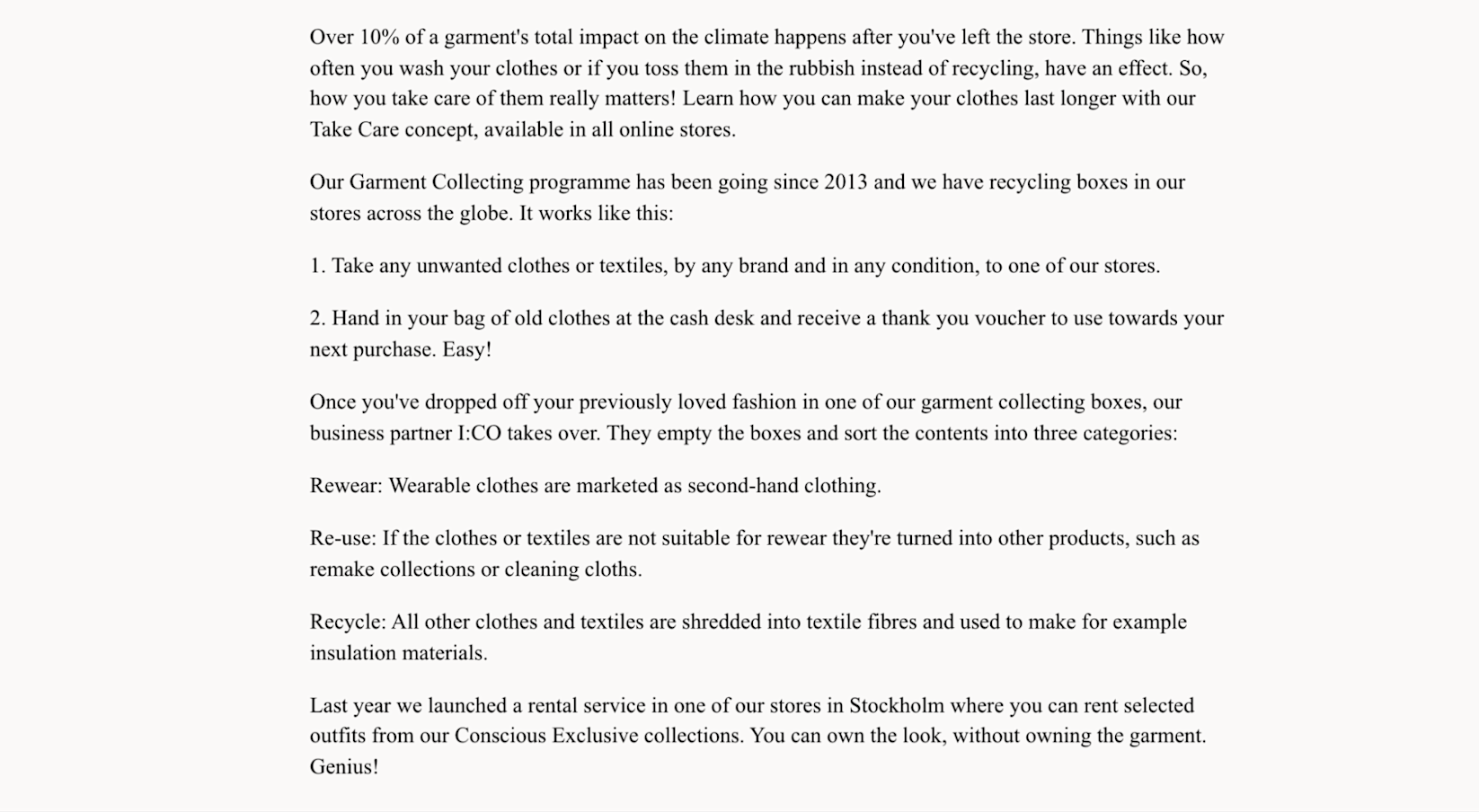
Bear witness your commitment to sustainability through your opposite logistics operations. Jon Carder, co-founder and CEO of Vessel, says, "Customers will participate in a visitor's reverse logistics practices when they experience they're doing something beneficial beyond themselves.
"1 instance is article of clothing retailer H&Thou. The chain collects used clothing in any condition at all their stores, and not just clothing that they've sold. The store uses the garments to create a clothing line made exclusively of used dress. This system empowers people to get involved with a brand that prioritizes an eco-friendly manner to sell clothing."
Collect important data
Include a render class as function of your reverse logistics process for insight into your products. Clarify them to find areas for improvement—tweaks to make to your inventory that could limit the number of products existence diverted dorsum to your warehouse.
Pay shut attention to:
- Items with the highest return rates
- Most popular reason for returns
- Common faults or damages
Permit'south put that into practice and say your hair straighteners are your most returned item. Three-quarters of people who return the item exercise then considering they didn't realize the product only worked on wavy hair. Foreclose this from happening—and your returns warehouse from being overrun with unsold inventory—by updating the product description on your website.
On the flip side, if yous're processing too many returns because the straighteners make it damaged, quality command your inventory, invest in protective packaging, or choose a new shipping supplier.
Contrary logistics challenges
Investing in a reverse logistics plan clearly has its benefits, but there are pitfalls to be aware of when planning your new procedure. Here are some of the biggest challenges when dealing with returns—and how to overcome them.
Customer expectations
In that location are only a certain number of hours in the twenty-four hours. And fifty-fifty with a large team powering your warehouse, processing returns and dealing with customer service queries is fourth dimension consuming.
The blunt truth is: customers don't intendance. They accept strict expectations for the returns feel—and many won't return to purchase from your shop if you don't hit the mark.
The biggest challenge for contrary logistics is the sheer corporeality of time it takes to process one return versus shipping out one order. It takes at least 2 to three times the amount of fourth dimension. This claiming is exacerbated by labor shortages in our warehouse team."
—Brian Lim, Founder and CEO of INTO THE AM
Solve this problem past clearly communicating your returns policy before the point of purchase. Explicate when a refund is possible, the window of opportunity to return inventory, and how long customers should expect to look for the return to be candy.
Quality control
Products involved in your return supply concatenation have been returned for a reason—be it that the customer ordered the wrong size or the item was faulty. A poor render logistics procedure leaves room for unsellable inventory to brand its style back onto the shelf.
Forbid this from happening by establishing quality standards. Have your team test all returned inventory, non only those labelled equally "wrong size" or "incorrect colour" on the returns form. Does it still have the tags attached? Does it show obvious signs of use? Any production should be in pristine condition before restocking.
Practice the same with whatever tertiary-party logistics providers you're working with to procedure returns. Share your quality standards with them and do random spot checks to make sure imperfect inventory is flagged.
It might seem similar you're throwing inventory abroad if information technology falls short of your quality standards, only remember the long-term impact. Reselling damaged inventory increases the likelihood of the aforementioned product being returned.
Lack of ownership
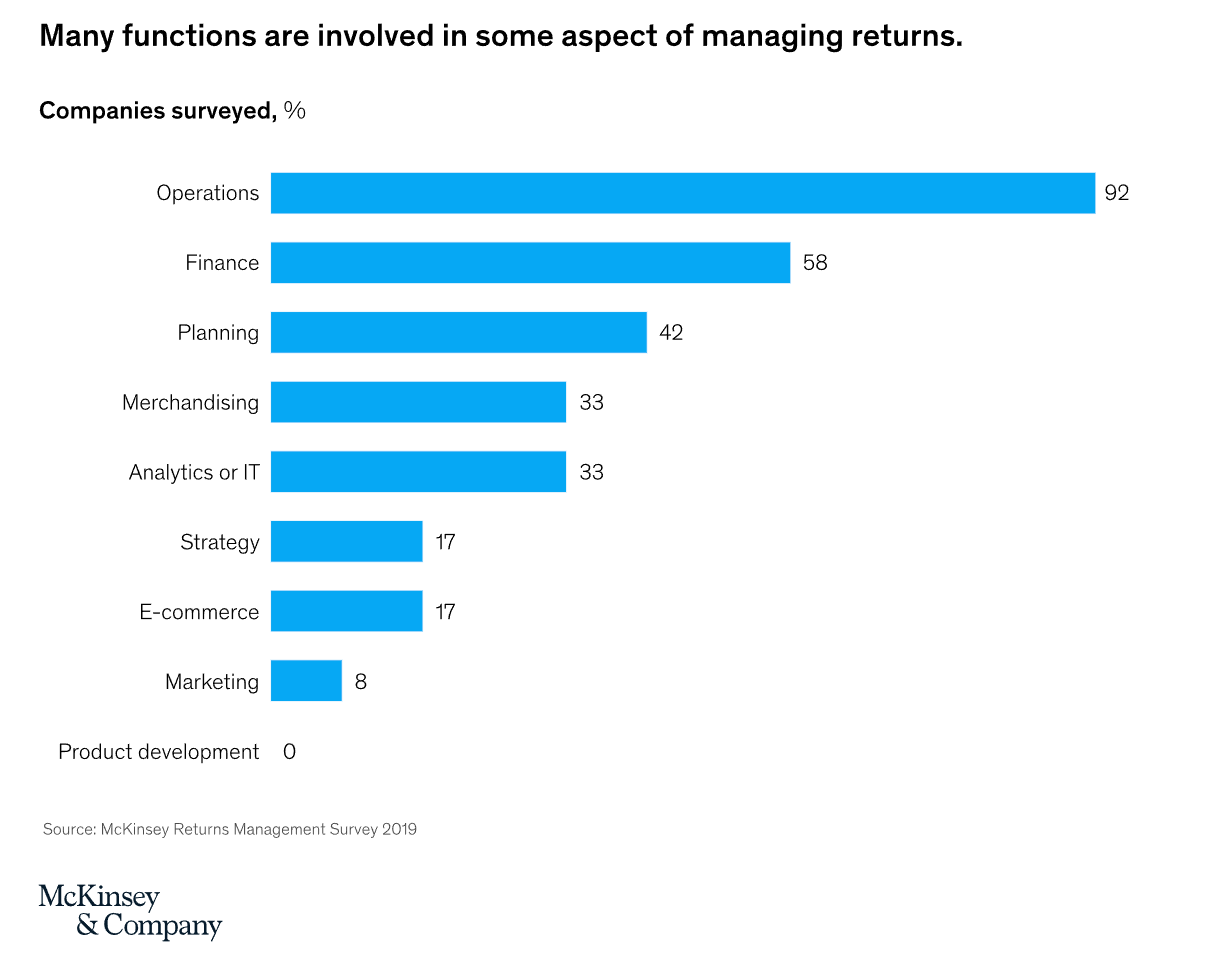
Who manages your reverse logistics process? Some retailers say their warehouse teams; others leave the responsibility with their operations manager. A scattering simply say, "We're not sure—it's a mix of different roles."
McKinsey & Company found that for 58% of businesses, a lack of accountability for returns management is a pain bespeak for the company. Nobody to control the procedure means the responsibility (and therefore, your returns) are passed from pillar to post.
Without an owner, structure, processes, or comprehensive metrics, it is no surprise that companies have struggled to prioritize returns management."
—McKinsey & Company
Overcome this problem by establishing a team to own your opposite logistics process. Scaling businesses could leave the responsibleness to the inventory management team, while brands in the $10 million acquirement range lend people from the supply concatenation team to manage contrary logistics.
How to implement a reverse logistics process
There's no mode around it: a opposite logistic procedure needs to be enjoyable for everyone involved, no thing how many client returns your business handles. There's a lot at stake—customer satisfaction and loyalty included.
Here's how to build a supply chain procedure that makes information technology quick and like shooting fish in a barrel to handle returns, without falling short on customer expectations.
Choose a returns aqueduct
The outset step is to make up one's mind how a customer ships the product back to your warehouse. Options include:
- Posting by mail. Should a customer want to commutation or refund the product, they tin employ a return label to post it back to the retailer. This option is preferred by 37% of customers.
- Render to the store. If you have brick-and-mortar stores, permit shoppers who've bought items online to return it in their closest store.
- Bundle pickup stations. Instead of pushing customers toward the postal service office, permit them to drib off their returns packet at a nearby DHL Service Indicate or UPS Admission Signal. Of people who cull this choice, 41% practice then because they're able to consolidate errands in the aforementioned trip.
From the retailer's perspective, one channel reigns supreme: in-store drop off. Not only tin processing returns in-store salvage up to 18 days in the opposite logistics process, but driving customers in-store could reduce returns and increment revenue.
More retailers are putting a heavier emphasis on 'render to store' as the more convenient option. That doesn't prevent returns, only it does make them toll less to the retailer."
—Nikki Baird, VP of Retail Innovation at Aptos
Customers who return items because they purchased the wrong size can easily get a replacement in-shop, eliminating the demand for returns altogether.
Plus, driving shoppers into your retail store gives yous another opportunity to sell to them. Provide in-store experiences, engage browsers with friendly retail staff, and place low-cost items next to the checkout desk—all of which are techniques shown to improve retail conversion rates.
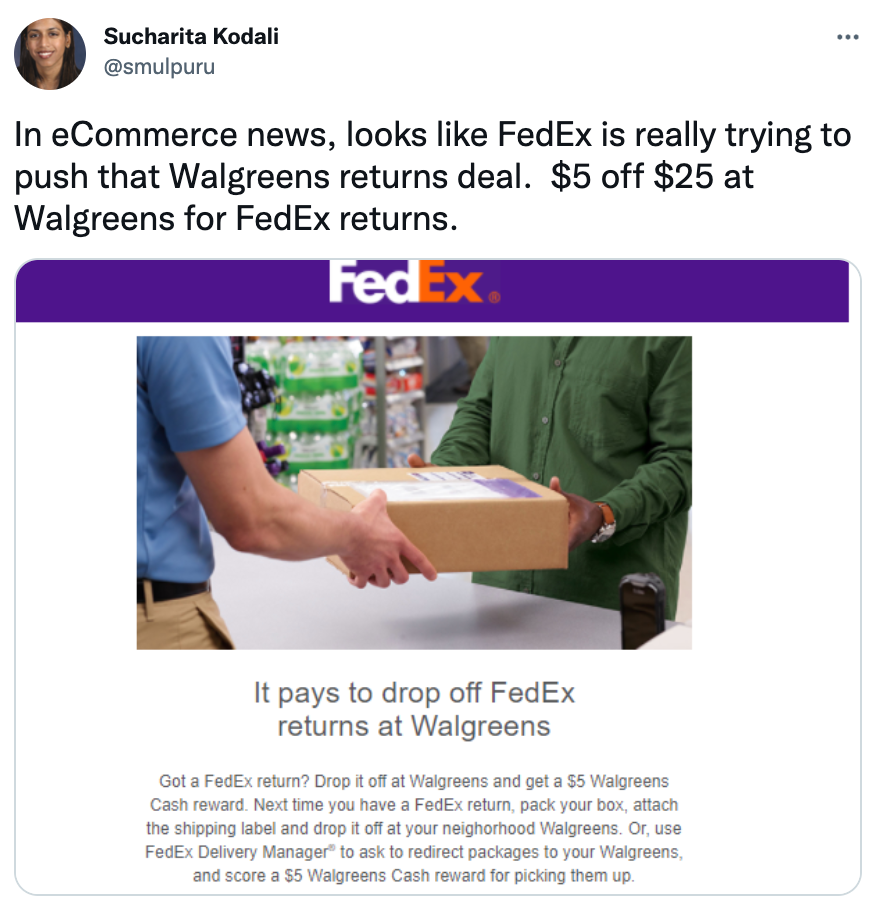
It's why brands like Walgreens are incentivizing shoppers to return FedEx items in-store.
Determine your return policy
A return policy explains the criteria an society (or product) needs to run into in order to qualify for a refund.
Not just can this minimize products beingness sent to the warehouse that you're unable to refund, but you tin increase the conversion rate of your online store. Some 54% of buyers are put off from purchasing a production they want if the retailer has a poor or unclear render policy.
Your render policy should include:
- Return window. How many days does a client have to return their item? A return window of 30 days can increase conversions past 57%.
- What qualifies for a refund. Does the production need to be unused with tags? If the official returns window has passed, does it still need to be under warranty in club to qualify for a refund?
- The blazon of refund on offering. Do you lot requite store credit, exchange, or money back?
- Who pays for return aircraft. Some 22% of D2C brands charge for return shipping, though many broil the cost of returns into their production price.
Need help creating yours? Employ Shopify's free refund policy template, then upload it to the policies section of your store:
Have a designated infinite to handle returns
One time items brand their way back to your warehouse, build a dedicated workspace for inventory to be processed and inspected.
"Sometimes returns can be messy and that can make you lot frustrated," says Erin LaCkore, founder of LaCkore Couture. "To avoid that, make sure that your system is designed in such a mode to divide returns into batches, separating them from the other incoming shipments.
Erin advises to "develop a dedicated receiving process for returns. Distribution centers should have a carve up workspace for the return shipments. They should have a proper procedure to handle the returns and as well train their staff on what to exercise to properly process returns."
If our production does get returned, nosotros accept a designated returns area that it goes to. From there, we tin can sort them effectively and efficiently."
—Jean Gregoire, Founder and CEO of Lovebox
Invest in render processing applied science
Enquiry from Rebound shows a quarter of shoppers think a delay in processing their return contributes toward a negative experience.
Fourth dimension is conspicuously important in the reverse logistics process. Nevertheless according to a USPS report, some 32% of companies say manual labor tasks—such as repacking and relabeling—are the biggest claiming to returns.
Speed things upward by investing in applied science that helps you process returns faster, such as:
- RFID scanners. Hands pinpoint the item beingness returned by scanning the bar code of a product. It's especially useful if you're processing large volumes of returns or accept like-looking SKUs.
- Warehouse direction software (WMS). Instead of recording returned inventory in an hands outdated spreadsheet, use a WMS. It'll pull data from your RFID scanner and automatically update stock levels.
- Industrial carts. "Retailers should consider incorporating the engineering with their reverse logistic process," says Nathan Watson, CEO of Lion Locs. "Powered industrial carts tin help increase efficiency and allow the employee to exist prepared for the render package."
Every single ane of our items has an RFID tag in it, which is non like a GPS or something. It simply allows clothing to motion through at a phenomenal speed through all the different checkpoints all while keeping the customer informed. Has information technology left the warehouse? Has information technology returned back? Very of import to our client and for our team to be able to rails where it is."
—Dean Jones, Co-founder and CEO of GlamCorner
Decide what to do with unsellable inventory
Earlier, we mentioned that quality control is a challenge for many companies. Every bit office of your reverse logistics procedure, establish clear guidelines for when an item can be resold.
Decide what to do with annihilation that doesn't hit the mark. Recall: the last matter you desire is unsold appurtenances cluttering your storage space, leaving less space for sellable inventory that generates revenue for the business.
Here's what that might wait like:
- Items with small wear and tear marks are relisted at a disbelieve
- Faulty products are sent back to the manufacturer for refurbishment
- Heavily damaged and unusable items are safely disposed of or recycled
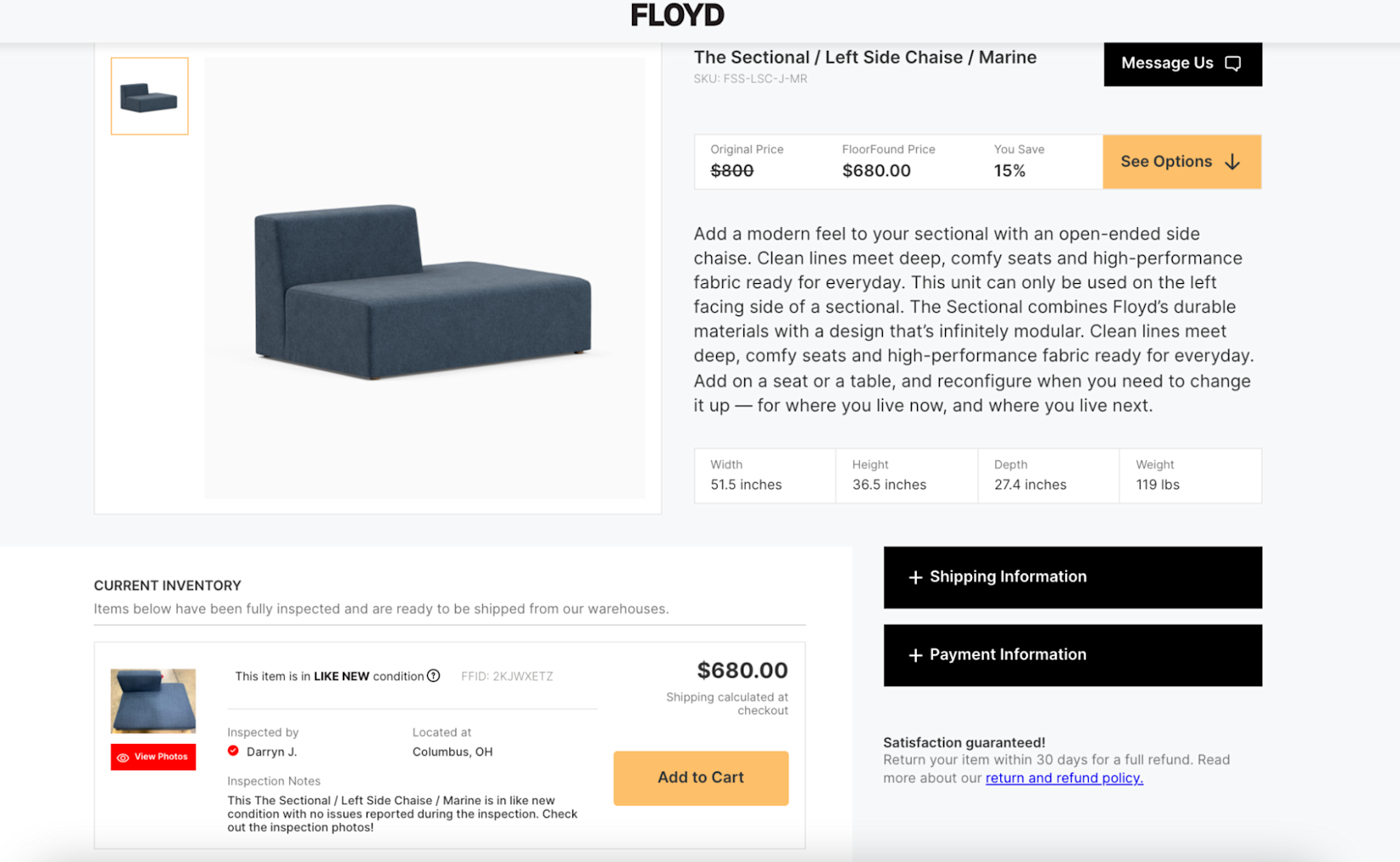
DTC furniture brand Floyd launched a resale marketplace to shift less-than-perfect inventory. The retailer collects unwanted items from a customer's abode and ships them back to the fulfillment heart for quality inspection. Items are graded and relisted on the marketplace with a discount of between 15% and 50%.
Should I outsource reverse logistics?
Reverse logistics has many moving parts. While it's possible to handle them internally, it might exist time to consider outsourcing reverse logistics once yous attain this point:
- You lot're receiving besides many returns to manage them yourself
- You're finding information technology difficult to deal with or dispose of returned inventory
- You don't take the upkeep to invest in a reverse logistics team or defended technology
Shopify Fulfillment Network is built for scaling ecommerce businesses. They'll store your inventory, and pick, pack, and transport orders across almost of the Usa within two days — freeing upwards your time so y'all can spend it on marketing, sales, client support, and annihilation else that will help you grow.
The best part? Customers tin send returned products back to a Shopify fulfillment middle. Their warehouse team will process the render and audit the production, returning sellable inventory back to the shelf in preparation for time to come orders.
Shopify Fulfillment Network is always looking at what our business needs and incorporating those needs into their new services and features. Equally a business possessor, fulfillment is only something you think about when it isn't working well and luckily I never have to think about it."
- Taylor Llewellyn, founder The Dad Hoodie
Need help with reverse logistics only don't have the option to outsource it completely? Choose a aircraft and return app that integrates with your Shopify store, such equally:
- Loop
- Happy Returns
- Narvar Render & Substitution
Ecommerce returns are inevitable
While in that location are steps you can accept to prevent returns from overrunning your warehouse, ecommerce returns are an inevitable function of running a business.
Customer retention is at risk if your opposite logistics supply concatenation doesn't see expectations or maintain inventory quality, or if information technology's too lengthy. And so invest in return processing technology, outline your refund policy, and categorize inventory based on whether it can be resold.
Shopify Fulfillment Network exists to take those tasks off your plate. Outsource your contrary logistics so you can focus on what yous do best.

Source: https://www.shopify.com/ph/enterprise/reverse-logistics
Posted by: greathouseinart1972.blogspot.com
0 Response to "Ab Investigative Services (Abis) Inventory And Warehouse Management: How Do We Handle Returns?"
Post a Comment